You are the only one that can change your situation

My wife and I were really stressed and in a bad space in late 2017. It was a terrible time in our marriage. We could not see the light at the end of our trouble tunnel. Somehow, we had to turn our finances around, but we also had a professional squatter in our rental apartment that was now costing us money, instead of bringing in an income. After long deliberation, we made the following tough decisions:

  1. We cancelled our DSTV subscription. 

  2. I cancelled my golf subscription and put my golf clubs away for the time being. 

  3. I sold my vehicle and bought a much older car.

  4. We changed our Medical aid to a much cheaper Hospital Plan.

  5. And in our own way, we said goodbye to most of our friends, because we were not going to see them for a while in an attempt to cut our expenses.

After realising that we were falling deeper and deeper into debt, we had very specific reasons why we had to change things. But realisation and having your reason why you should make changes gets you to the edge of the cliff. Taking the dive into the water 10 meters below would actually need action to achieve the result.

We were blaming each other for the position we were in. We were right. Both of us were to blame. We were both adults. We had been enjoying life in our comfort zone. Me, more than my wife. I think I did own up to this. It was time to act like adults. Nobody else got us into this situation but ourselves and no one but ourselves will get us out. We appointed the agent that placed the tenant without asking for the relevant paperwork. We had to fix this. We had to take ownership.

One of the books that changed my life was Extreme Ownership: How U.S. Navy Seals Lead and Win by Jocko Willink and Leif Babin. Reading became part of my life at this time and helped in so many facets of my life. It gave me a new perspective and helped me switch off from my problems by reading a few minutes before bedtime. I really suggest making reading part of your life and this book is a great start.

This book made me realise that there are really two kinds of people in life. The ones that give other people the blame for their problems and the people that get and solve the problem or approach it differently in the future. The people that are stuck in their comfort zone and the ones willing to move outside of their comfort zone, to find solutions.

Blaming others for our problems, not owning up to potential problems and not being willing to make sacrifices, are all examples of being stuck in our comfort zone. Naturally, we would rather stay in bed on a cold morning, or watch our favourite TV show on our comfortable couch than go for a run. Naturally, we want to blame others or outside factors for our negative feelings, our bad mood or our problems.

Just yesterday I was on my phone talking to my wife while driving and almost missed my turn-off. I suddenly had to switch lanes and when a vehicle didn’t give me the gap I was hoping for, I took my frustrations out on the driver. After I cooled down, I realised that if I wasn’t on the phone I would have been more prepared to take the turn-off and all the unnecessary excitement could have been avoided. 

Most of us have experienced road rage to some degree. The reality is that most of our rage can be spared with a little planning, be it planning for a little traffic – because it’s almost inevitable on certain roads – and leaving earlier or having a good idea of where we are going and how long it will take, before climbing in our vehicle and just driving to a new destination.

When it comes to personal finance, we must take ownership of our expenses. 99% of the time, we are able to cut our expenses, it just needs one more step. I sold my 2-year-old car and bought a 9-year-old car to cut expenses. I know someone that not only did the same, but also sold his house, took a loss and moved to a garden flat. Within 3 years he got his finances back on track. 

Learn how to spend only 85 per cent of your income, or one day you will be forced to live of a lot less.

-The Van Plan

“I just want to enjoy my money for the time being”, the millennial said. Enjoying 100% of your money in your 20s, 30s and 40s, would cause you to not have money to enjoy later in life. At some point debt, inflation, a negative salary increase to inflation or a combination of these will force you to make changes – often too late. Enjoying 85% of your income in your 20s, 30s and 40s, will ensure that you will always have money to enjoy.

Why don’t we have the mindset of, “I just want to enjoy my freedom as soon as possible and not have to work for a boss all my life”, in our twenties? 

Not spending all of our income is a mindset. It starts with some financial literacy, tweaking a few habits and fully embracing the reason WHY you want to do this. In a previous post I talked about the importance of the WHY. Later on in the blog I will also explain how you can get the mindset right and how we turned our finances around by changing small habits to cut our expenses.

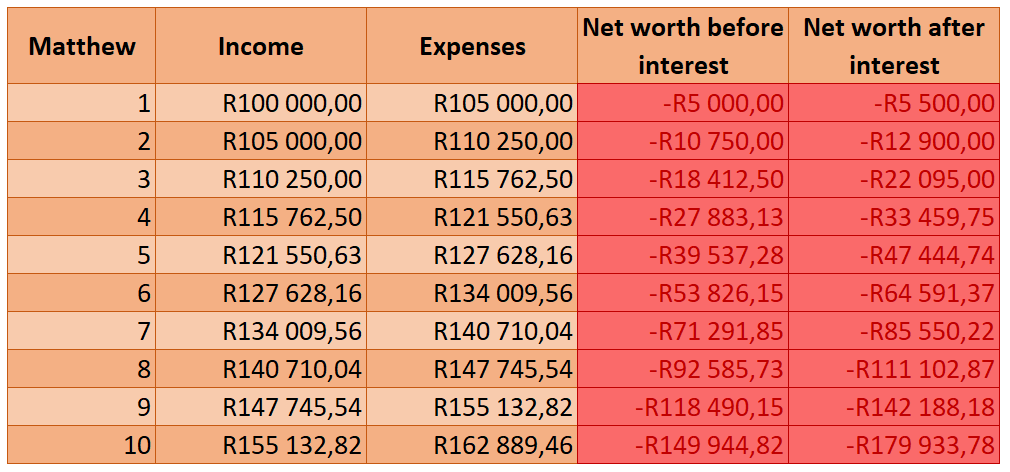
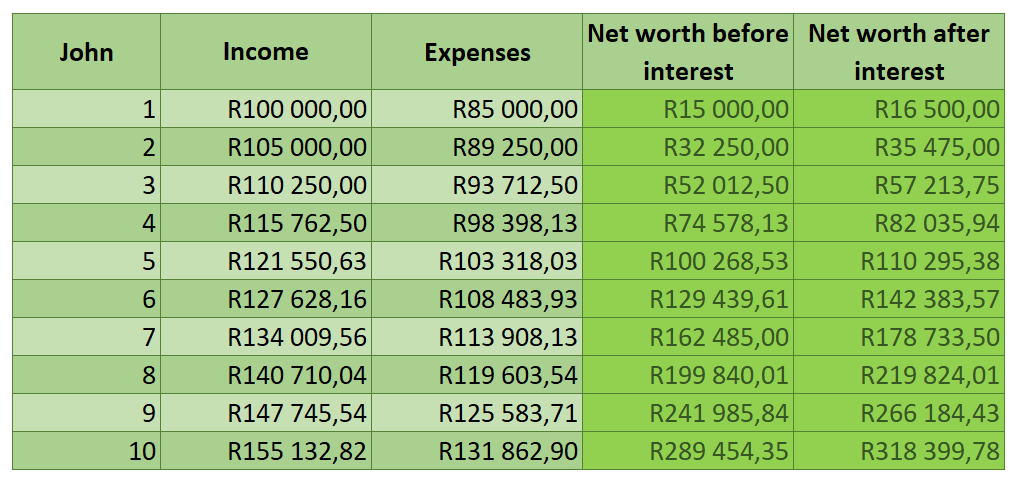
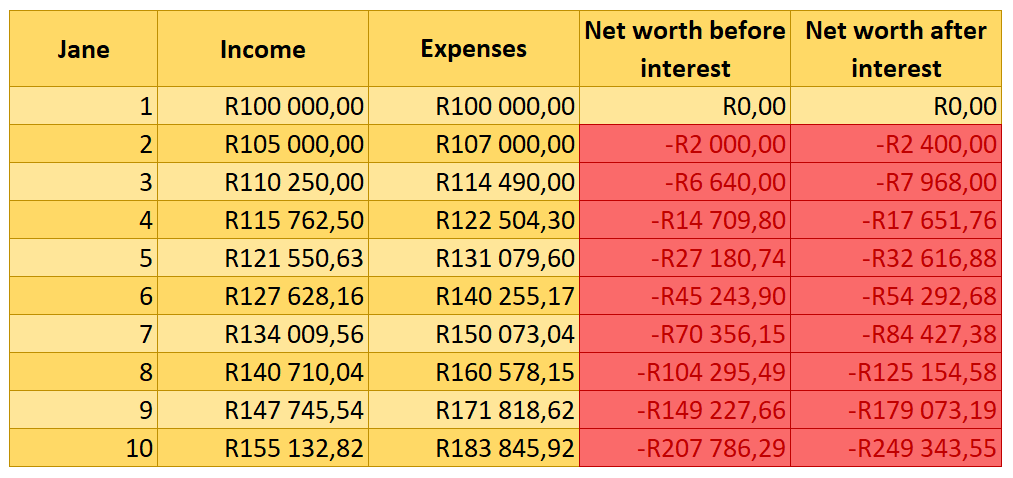
In the following example, I illustrate how different spending habits can influence their net worth over a 10 year period. John, Jane and Matthew each earn R100 000 in the first year. John only spends 85% of his income and invests any surplus @10% interest. Matthew continuously spends 5% more than his income. Jane spends all her income in her first year and then fails to adjust her expenses due to the cost of living increase. The interest on an overdraft account is 20%. Inflation is 7% each year and each of them gets a 5% increase each year. This is the effect of different spending habits over 10 years.
Matthew has not only neglected to put money away for unforeseen expenses, emergencies or the day that he cannot earn an income anymore, he has also racked up debt that will take him more than 10 years to pay off even if he changes his spending habits to only spending 85% of his income in year 11.

Jane is even worse off due to the fact that her income could not keep up with her expenses. Not having a clear understanding that she effectively had a negative 2% growth year on year on her salary, has put her in a very difficult financial position.

John on the other hand has done well to save up 24 months worth of income. He has put himself in a position where he has various options. He can try and start his own business while not worrying about an income for 2 years. Or keep on saving as he has and after another 18 years of sticking to this formula, the interest on his savings alone, will cover his expenses. This will give him even more freedom in life.

It is quite clear, learn how to enjoy 85% of your income and you will enjoy the rest of your life. If you use 100% of your income to enjoy life, the time will come when you must learn to enjoy life with only 50% of your income or decrease your enjoyment dramatically.

In life, there are really only two types of people. The ones that make excuses for their problems and the ones that accept their problems and do something about it. Which one are you? The one that hopes for a miracle or the one that makes the miracle happen.

My “Why”. Why did I embark on this journey?

In the previous post, I mentioned the importance of being very specific about your Why? Why will you do what you plan to do? Why will you start changing your habits? My story also started with Why. In fact, there are two parts to my “Why?”.

The first part started when I realised that I was on the same path as my parents – not building assets early enough in life to become financially independent. Rising unemployment, inflation averaging around 6% and salaries not being able to keep up with the rising cost of living, all contributed to my “Why?”. The risk was simply too high to keep on living month to month and not build any assets or a passive income. I wanted my money to work for me as soon as possible, rather than working for money for the rest of my life.

As a kid, I always had aspirations to become an entrepreneur and I had no doubt that I would become successful one day. But somewhere between high school and my mid-thirties, this conviction became a fading light, dimmed by bad habits, bad health and friends that did not get the best out of me. I think this happens to a lot of us. We have these amazing dreams while we are still at school, but after school, the freedom of hanging out with “friends” for hours and partying several days a week, sets habits in motion that we struggle to get rid of. For about 17 years, my life was in limbo. My so-called “success” was relying squarely on a lottery win or a get-rich-quick scheme. Oh, how naïve was I?

Thinking back, I cannot believe how much time I wasted doing the same thing over and over again for about 17 years. I grew very little mentally and emotionally during that time. Physically I grew a lot. I was overweight, unhealthy, tired and of course in so much debt. I sometimes wish I could “Ctrl Z” this phase of my life, but now I know that it was part of the journey.

I finally came to the realisation that I had to do something about this, and this became the first part of my “Why”.

In which phase are you in your life? Are your childhood dreams still alive? Are you giving them your best shot or have you given up on them?

The second part of my “Why?” is to help other South Africans realize that they could end up like my parents and so many other elderly. I wanted to do more than just tell the story through a blog, I wanted to walk the talk; put my theory into practice to prove what is possible.

My Why was clear. I am passionate about this project, because I feel that most middle-class people in South Africa are oblivious to the fact that they are sitting ducks for the big organisations that want to get their hands on our hard-earned money. Not that they are uneducated, but that they are up against a multi-billion dollar machine. It is estimated that $522,5 billion dollars was spent on digital advertising worldwide

Retailers, Governments and Influencers are to name a few urging us to spend unwisely so that they can fill their pockets. I believe it is time to educate ourselves, be more aware of the sly tricks of the scavengers and take back control of our finances. After all, we can control them. We are the ones that vote them into government, we pay their salaries through taxes, we feed their bellies by buying in their shops and we decide their existence by following them on social media. 

For some people, this blog will be controversial, simply because it challenges the very beliefs that we have grown up with and goes against the ideas that have been etched in our minds for many years. I dare you to do introspection, and give some of the ideas a chance to grow on you, before making up your mind on their value.

Before I published this blog, I found myself doubting if I should in fact publish it. “Who would even read it?”, “Why would they care about what I had to say?”, “Why should I run the risk of being criticised by other people when they disagree with my ideas?” After all, I am a relatively private person and am okay with that. My life is as good now as it has ever been. I don’t worry too much about money, because I have no bad debt and have taken control of money. I have everything that I need, because I’ve changed my mindset and I feel like I’m growing every day, because I have changed my habits.

And then, just as often as I doubt myself, I also reassure myself that even if I help 5 people when 10 people criticise me, I have done more with my life than I would’ve if I had not published this blog. Ever since reading The Alchemist, by Paulo Caulho, I believe that this blog is part of my journey to help others. I truly hope I can find the words to resonate with you and keep you interested until you have become the best version of yourself.

How to make the decision to get your finances in order?

“I really don’t know where we are going to cut costs. We are already living as cheaply as we can.” With these words to my wife, I tried to take the easy way out. Fortunately, the reason WHY we had to cut costs was greater than the reason not to. 

Even though my initial reaction was that we could not cut any costs, we were able to cut R15 000 (±30%) off our monthly expenses over the following 12 months. It started with some sacrifices and small cuts; larger cuts followed and eventually, we started paying off debt that freed up money to pay off other debt faster. In a later blog post, I will explain in detail what we did and how we did it. For now, the point is: Where there is a will, there is usually a way, and it all started with WHY.

So, how strong is your will? How important is your reason WHY you need to get your finances in order? In my case, I found out that my parents are not in a position to retire and the burden of their poor planning could become my problem.

Less than 6% of South Africans can retire at 65

Trust me, poor retirement planning is a prevalent problem in South Africa. Statistically, less than 6% of South Africans are in a position to retire at 65. Most of them have to cut their living costs to be able to do so.

My second reason for making a change to my finances was my ever-increasing debt. For a few years, I received a higher income due to the longer hours we had to work on a project. It was not an increase, but rather a top-up for overtime. When the project came to an end, the top-up went away, but not my increased cost of living. My debt increased rapidly and I was oblivious to the fact, because technically my salary was still the same. It was just the added benefit that went away. It took me a while to realise the impact. We did not have a budget or a system in place at that time, so we didn’t really understand what was happening in our finances. It just happened.

And then, the worst thing happened to someone with increasing debt. Our new tenant in our rental unit stopped paying her rent in month 2. Our cash flow was already in the red, and now another income stream was shut off. What was worse, is that we would have to spend money (on legal fees) to sort out our latest problem. This trouble-tenant would cost us about R150 000 in written-off outstanding rent, legal costs to get her evicted and interest on debt that we had to incur due to her. The value of the lesson – we were at fault for placing this tenant – and the wake-up call, was worth so much more. Not many of us are fortunate enough to get such a wake-up call early enough in our lives.

We realised that if we do not get proactive with our retirement planning, one of three things will happen:

  1. We would have to work until we died. This is simply not realistic as at some point you become less valuable to an employer, due to not being able to perform tasks to the level that you were previously capable of. Your salary will eventually decrease and you would not be able to keep up with your standard of living.
  2. We would end up in a caravan park living off a state pension. I don’t think I have to explain this one too much. It simply was not an option.
  3. The burden would fall onto our children. If you ask me, only parasites live off other organisms at the other’s expense. How could we possibly justify getting children when we know that they would have to look after us one day?

It was quite simple. Become Financially Independent before it is too late! Here are our reasons WHY:

  1. Money will control you until you take control of your finances. I have fallen into the cycle of being dependent on a salary, but it is my choice to stay in this cycle or take control of my expenses and get out of the cycle.
  2. The sooner I can build enough passive income to cover my expenses, the sooner I can do what I love. Travelling the world is something both my wife and I enjoy. The sooner we take back the power of who controls our time, the sooner we can do with our time what we want.
  3. I do not want to be a financial burden for my loved ones. Life comes with enough challenges. To expect someone to look after you financially is not only selfish, but shows poor judgement and planning on your side.

An illustration of Simon Sinek’s “The Golden Circle” from his book ‘Start with Why’

When Simon Sinek wrote ‘Start with Why’, he had businesses in mind rather than individuals. His message was, people don’t buy what you do, they buy why you do it. For example, people don’t buy a car, because it is a car. They buy it because the company sells it as the ultimate driving experience. Now, my message is: “The reason for doing something; doing it with vigour and actually completing what you started, is not what you will achieve, but rather why you want to achieve it.” Nobody gets excited about financial independence (retirement) until they think about WHY they want to achieve financial independence.

If you can convince yourself upfront that the result will be worth the effort, you are halfway there. It makes the difficult tasks so much easier. So take a few moments and think, why is it important to you (and your family), to take control of your finances?

  1. Is it to retire early?
  2. Is it to give your children a kick start in life?
  3. Is it to get out of the rat race?
  4. Is it to make a fresh start in another country?
  5. Or perhaps to travel the world one day?

If it is not important enough, you won’t make a single change. The stronger your reason why you want to change your financial situation, the better the chance that it will motivate you to make a change. You have to be obsessed with your reason. Write it down and put it up where you can see it. Make it part of your daily routine.

One of my friend’s family owns a Family Resort. Other than offering chalets and camping sites, it also offers a separate area for long-term residents. Here you get people who are retired and come park their caravan for months until they decide to pack up and move onto the next resort.

You also find people that come and park their caravan here to save costs. A stand that includes water and electricity, could cost less than R3 000 a month. Some have enough income to live in the city, but they prefer to live in a caravan for 9 – 10 months a year, to enable them to travel for the rest. Their reason WHY, is to travel the world and see new places.

Other occupants have children in Australia. Their reason WHY, is to save money to visit their children. There was even a young family of four, that moved to the resort during COVID 19, because they fell into hard times in the city. With their move to the resort, they could save costs and pay off the debt they had until they were back on their feet. Working remotely enabled them to earn an income despite living more than 100km away from their offices. They made the decision as a family and made sacrifices together. They realised that negative cash flow will only bring more hardship. Their reason WHY, was to break the cycle of negative cash flow.

There are many ways to solve a problem, it just depends on how badly you want it. How strong is your WHY?


The difference between the impossible and the possible lies in a person’s determination

-Tommy Lasorda

The message in the blog is not to stop spending on luxuries or start living on bread and water. The lessons in the blog will teach you to become more financially savvy and guide you to a positive cash flow as well as a growing net worth to set you up for financial freedom. 

It won’t be easy. If it was easy, everybody would be financially free and there would be no need to write about it. You must be prepared to make certain sacrifices. Nobody has ever improved their status quo without a sacrifice of some sort. If you want to lose weight, you need to eat better or exercise more or even both. To get a promotion at work, you might have to study further.

Where there is a strong enough will, there is a way. We are sometimes just too proud to lower our standards of living. Make sure you understand the repercussions of your pride.

Start with having a conversation with your trusties (your besties that you can trust). You will be surprised how many people go through the same struggles. If you don’t feel that you can talk to someone, contact me. I have been there and I have been able to change things around to a great extent.

My goal is to not have to rely on a salary to make ends meet within the next 15 years – my journey already started 6 years ago. I want to earn my income from anywhere in the world and keep a positive cash flow at all times while increasing my balance sheet until the day I die. WHAT are your financial goals? HOW will you reach it? WHY is it important to achieve it?

The first step to changing your financial future

In 2016, I was drowning in debt. Between me and my wife, we had 3 Credit cards, well in the red, 2 personal loans, 2 overdraft facilities well in the red, a car loan and we just had our first child. Our bad debt stood at about R350 000. We also had 2 home loans, but let’s call that “good debt”.

We were about to find out that my parents were in no position to retire at 65, with just 5 years to go and there was a genuine chance that I will have to help them financially in the near future. We would have carried on living from month to month for years to come, but then the worst thing possible happened to someone drowning in debt… and that changed my life.

Today (October 2022) I am in more control of my finances than ever been… even after quitting my job and have not yet applied for a new permanent job, 12 months later. I am free of the burdens of financial stress. I understand my financial situation, being in control of my spending and understanding the limits of my income. I don’t have any bad debt, I have a diversified investment portfolio and I earn a passive income through four streams, with another running at a loss, but hoping to turn it around soon. It’s not a big income yet, but it is a step in the right direction. In my first post, I talked about how I believe that middle-class, salary-earning South Africans are in real danger of falling into poverty over time. Creating passive income streams is the way to counter this.

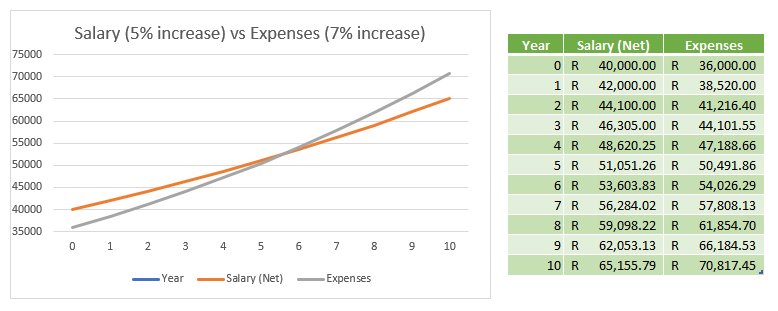
The graph shows how quickly your expenses catch up with your salary when you get a 5% salary increase, but your expenses increase by 7% year-on-year, if you spend 90% of your income in year 1.

For most of my life, I’ve thought of myself as a problem solver and more than adequate at mathematics. Unfortunately, this did not reflect in my finances. My finances reflected ignorance and someone detached from reality. I was very lucky that I was slapped in the face with a reality check not once, but three times between 2016 and 2017. If it was not for this, I probably would never have turned my finances and simultaneously my life around.

In essence, I had terrible financial habits and although I wouldn’t accept it myself back then, I was lacking financial literacy. I had no idea how much money I would need to be financially independent and with time I learned that this was not an isolated case.

Financial Independence according to Wikipedia is the status of having enough income or wealth sufficient to pay one’s living expenses for the rest of one’s life without having to be employed or dependent on others. Income earned without having to exchange your time for it is commonly referred to as passive income. Growing your passive income over time to eventually cover all your expenses, will make you financially independent. I prefer the term financial independence to retirement, as we have an age correlated to retirement; even an image of someone well into their life. Grey hair with wrinkles; an older version of ourselves, but a happier one due to the freedom of retirement.

I get the idea that a lot of people think that they will retire at age 65 no matter what. Somewhere in their life, they put money away towards a pension or provident fund and therefore they can stop working at 65. Unfortunately, this is where the very big misunderstanding starts. This is why I like to refer to such a time as financial independence. It can happen much earlier than 65, but due to our very bad financial planning it usually happens way after 65 and in most cases never.

There are very easy calculations that you can do to guestimate how much money you need to become financially independent:

For example, take the monthly income you feel you would require and multiply it by 300. It is not a perfect solution, since many factors would influence the result, but it is good enough to set your thinking in motion to where you should aim.

If you and your partner feel you need R40 000 a month to live comfortably:

R40 000 X 300 = R12 000 000

Why did we do this? In the financial industry, they talk about the 4% rule. This is where you live on only 4% of your capital in an attempt to preserve your capital since you don’t know how long you will live. Therefore 4% of R12 000 000 equals R480 000 per year or R40 000 per month. Why do we use 4%? In order to keep the value of our capital over time, we need to keep up with inflation. South Africa’s inflation target band is between 3% and 6%. Unfortunately, we have been closer to the upper side of this band in recent history and therefore if you can grow your capital around 10% annually, you can only draw 4% annually to keep the value of your capital.

What is important to understand, is that the R12 000 000 is in today’s value. You will have to adjust your target every year to stay with the rising cost of living.

What even more people miss is how long it takes to save up this sort of money. This is not an amount accumulated by putting a few hundred rands into a savings account at your bank. This takes careful planning for many years. My Financial Planner gave me an example that shook me to the core. The example he used ignores inflation and interest for ease of concept. Or if you want to be more practical, you live in a country where inflation is 6% and the bank you save your money, gives you 9%, but after taxes, your real return is 6%. Inflation and interest balance out.

If you are 45 years old and plan to put money away until you are 65 (for 20 years), and plan to have saved up money to pay you R40 000 per month for 20 years (until 85). How much do you have to put away?


The answer is R40 000 per month for 20 years. Since it is the same timeline for saving and spending, the same amount is required. 

What if you double the amount of time you give yourself to save for retirement and you start at 25?

You will need to put away half of what you required if you only saved for 20 years, thus R20 000. It is still scary. Who can save R20 000 of their salary in their 20s. Fortunately, there are a few things that can help. Sound financial advice, the maximising of tax incentives, the increase of your earning potential over time, time in the market and compound interest can make the load a little lighter, provided that your interest beats inflation. But don’t think you can put R1 000 a month away at the age of 45 and reach your goal.


So, what do YOU need to save monthly to reach that goal? This is a slightly trickier equation since there are some unknowns, like your current age, your goal financial independence age, your goal income at retirement, what inflation will be over that period and what interest your investment will enjoy over that period., but using a professional that sees you on a regular basis to do active planning and make adjustments where necessary can help you reach that goal. 


Many people, unfortunately, have not come to the realisation that they could find themselves at 65, wanting to retire, but not in the position to do so. That is why I strongly suggest that you talk to an expert to understand where you stand with regard to your financial goals.


The first step to turning your life, let it be financially, physically or mentally, you have to realise and acknowledge that you are on the wrong path. If you don’t know it, you won’t change it. Alcoholics or drug addicts don’t change their lifestyle, simply because they think they are in control and can change things around when necessary, but they can’t see their pitfalls or blindspot. They see what they want to see.


Admitting that we are on the wrong path is probably the most difficult step, but it is only one phone call or email away. Most financial planners do a free financial needs analysis. By playing open cards with them, you can find out what is required to get back on track with your financial goals. If you don’t have a financial planner, click here and I will put you in contact with someone.

” 

If you think education is expensive, wait until you see how much ignorance costs in the 21st century.

 – Barack Obama

In a world where it takes little for a teenager to give advice on which stock to invest in to become a millionaire, it is really important to be careful who you take advice from. “Fake it, ‘till you make it” is every other side hustle’s motto. Why would you take advice from someone if they can’t prove their qualifications? 

Would you allow a lawyer to give advice on a worrying heart condition? Would you allow a doctor to give advice on a legal matter? So why do you let someone other than a financial professional give you financial advice? Is financial independence or earning an income when you are not able to work anymore not important?

Corruption is Country Cancer

One late Thursday afternoon in November 2022, a maintenance contractor reaches out underneath a rotating shaft to unscrew a steel plug, smaller than a coffee mug. The removal allows lubrication oil, vital for the smooth operation of one of the eight turbines at Camden power station to operate, to leak freely from the very part it must protect. Within minutes the overheated bearings come to a smoking halt. This act of sabotage will most likely enable another inflated contract for the corrupt repair company.+

Read the full story here.

If you think this is bizarre, read here:

Eskom paid R80,000 for a pair of knee guards that cost R320

At Builders Warehouse

Eskom paid R200,000 for a wooden-handled mop which costs less than R100

At most stores

Eskom paid R26.00 per single one-ply toilet paper roll, which costs R3.99

At Checkers

Eskom paid R51 per black refuse bag, which costs R2.99

At Checkers

Article by Daily Investor

If thus didn’t shock you, replace the word “Eskom” with “Taxpayers”.

Electricity prices have gone up by 550% in the 14 years illustrated in the graph below. How much did your salary increase in the last 14 years?

Average annual electricity tariff hikes vs inflation. Source: Anton Eberhard (@AntonEberhard)

Over and above the increase in our electricity bills, we have further bailed out Eskom from a complete blackout due to crippling debt. Unfortunately, corruption does not end with Eskom.

In 2020, then finance minister, Tito Mboweni, confirmed that the cumulative bailouts for state-owned enterprises since 2000 were R187,4bn to date.

This is money that gets recovered from taxes. You and I are indirectly paying so that someone can make a 200 000% profit on a mop or a 25 000% profit on a pair of knee guards. If this does not upset you, you are better than me.

Years ago, South African SOE’s were putting money into the overall state kitty. For the last 20 years or so, taxpayers have had to keep State Owned Enterprises afloat. Did you know that Eskom won the Financial Times’ Power Company of the Year at the annual Global Energy Awards in 2001? By December 2022, Eskom’s debt stood at R422 billion. It takes a special effort to take down South Africa’s once-world-class power utility in such a quick space of time. 

At the end of March 2023, National Treasury announced that the government will provide debt relief to Eskom amounting to R254 billion over the next 3 financial years. Where do you think government will get this money?

The government has already increased fuel levies and VAT in recent years to try and fill the holes of corruption. Both contribute greatly to the eventual prices of goods and services. Next time you buy food or clothes, think for a second about how fuel and VAT affected the price of the respective item. Was it transported at any point in its cycle from being in its natural form to when you bought it? Was VAT paid on importing the article or on any material it is packaged in?

Corruption is a massive contributor to inflation; the middle-class’ greatest enemy. You can also thank inflation and therefore corruption for the recent hikes in the prime lending rate. The South African Reserve Bank pushes the repo rate up to control inflation. How does this work? When the lending rate is low, people tend to spend more money, which means that demand is high. When demand is high, product prices gets pushed up. When the lending rate goes up, demand slows down, which in theory will force prices and also inflation down. This is the basics of an economy. Unfortunately, corruption adds another dimension to this equation. When tenders do not get awarded to the best and most price-efficient contractor, due to corruption, the mitigating measures to stem high inflation get nullified.

In the title of this article I use the metaphor to implicate that corruption is like a cancer for a country.

Cancer can go unnoticed for a long time, but when it gets detected, it can be too late to treat.

Cancer is a disease in which some of the body’s cells grow uncontrollably and spread to other parts of the body. Cancer can start anywhere in the body with trillions of cells.

With early detection and treatment, cancer can be controlled and even cured. But ignoring sure telltale signs can have devastating effects.

In the same way, corruption can go undetected or ignored, purposefully or through ignorance. When the real effect of corruption gets realised it has spread to such an extent that key players in the supply chain or in the policing system are already caught up in the claws of the main benefactors. In some cases, the co-operatives are not necessarily willing, but threatened to such an extent that they do have a choice. Or the bribes that they receive are simply too lucrative to waive.

In 2021, University of the Free State chancellor, Bonang Mohale gave the following sickening results: “It is broadly estimated that there was a whopping R1.5 trillion lost to our country between just 2014 and 2019. This is not to mention that some of our elected leaders continue to steal from the poor, hungry, sick and dying.”

Have you ever seen the Netflix series “Narcos”? For me, this was such an eye-opener on how a drug cartel captured a country, from the police to the government and then made the people believe that the drug lords are the good guys. The amount of corruption, whistleblowers and good guys that get assassinated, made me wonder how far South Africa is away from that.

I can’t help but feel, that the recent assassinations of politicians, whistleblowers and the attempt on the life of a recent CEO of Eskom that has laid bare the corruption and sabotage at Eskom, is the direct influence from the kingpins that gets the biggest monetary benefit from the deals mentioned at the beginning of this article.

If you have never watched Narcos, I can really recommend it for the brutally honest telling of how the greed of the drug lords leads to thousands of deaths, and the destruction of communities and eventually cities for the enrichment of a few. It opened my eyes to the lengths that the benefactors would go through to ensure their riches.

Just be warned that it comes with a warning for sensitive viewers.

The idea of this post is not to point fingers at anybody, but to rather open the eyes of salary earners to the destructive nature of corruption of their own wealth.

We all know the story of Hansie Cronje. Once the darling of South African cricket. I think we all accept that Hansie was not a bad guy. He just had one bad trait. His love for money. He was lured in slowly, and before he could get out, he was tangled in the sly web of match-fixing.

Corruption will always be around. In recent years the man on the street has come to understand that our leaders whom we once backed to grow our economy, are now the ones caught up in the ever-growing snowball of corruption. I don’t think that all people caught up in corruption, planned to get involved. They were just the connection. The syndicates; the real benefactors, would not allow anything to stop them from getting their slice of the pie.

So how does corruption contribute to inflation and ultimately the pockets of the salary-earning middle class?

Corruption led to loadshedding through money ill-directed at procuring products at inflated prices that could have been used for maintenance. It was also caused by appointing incapable contractors to work at exorbitant prices, leading to rework and longer downtime. Eventually, Eskom ran into so much debt, that the only way to keep the lights on, sometimes, was to gather bailout money from the taxpayers. Add to that, that SA is running out of taxpayers, and you should realize that the time to plan your finances with professional help is now.

As a friend said the other day. South Africa is at the mercy of the good religious values of their people to triumph in the long run, but it takes only a few corrupt officials in strategic places to bring our country to its knees. One rotten apple spoils the barrel.
 

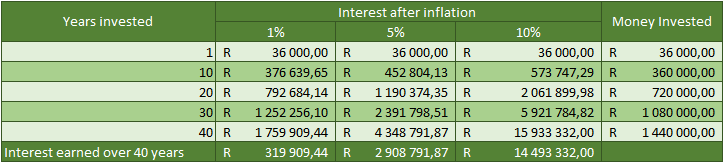
The middle class will always bear the largest brunt of the effects of corruption through taxes and levies. If it doesn’t affect you directly, you will eventually be affected by the rising cost of living, or inflation. You might as well accept it, get in the game and start playing it. The South African Reserve Bank’s inflation goal is between 3-6%. Inflation, as I write this, is hovering around 7%, which means that your investment needs to outperform 7% after tax. Here is a graph that illustrates how a saving of R3 000 a month can grow in relative terms if you can beat inflation by various percentages.


In the first column (1%), we look at the scenario where you get 8% on your returns and only outperform inflation by 1%. You should be able to achieve this with a fund with a decent track record.

In the second column (5%), we see a scenario where you outperform inflation by 5%. This can be achieved in an investment with 8% returns and when the lower inflation goal is achieved by SARB. Or in an investment that outperforms our current inflation by 5%. An investment that gives returns of 12% after tax is rare.

In the third column (10%), we see a scenario where your portfolio outperforms inflation by 10%.  This can be achieved in an investment with 13% returns and when the lower inflation goal is achieved by SARB. Or in an investment that outperforms our current inflation by 10%, therefore 17% after tax. This is very rare, but possible with good financial planning, taking advantage of tax incentives and staying in the market for a long period.

The first objective of this illustration is to show that the higher inflation is, the more difficult it is to save for retirement. The second objective was to show the advantages of starting early and getting good professional advice.

If we look at the last row, we can see the interest that was accumulated over 40 years. At 1%

Your interest over the 40 year period is only 22%. If you are able to beat inflation by 5% consistently over 40 years, your interest is more than double the money that you physically invested. And if you can beat inflation with more than 10% over 40 years, your interest earned will be more than 10 times the payments that you made over the period.

Every percentage of inflation makes it more difficult to save for retirement and corruption is contributing in a big way towards our soaring inflation.

Corruption is deeply embedded in our country. Like cancer, it is not a quick fix to get rid of it. It is a stubborn weed that is difficult to get rid of completely. High inflation is most likely here to stay. You can use it as an excuse to not do anything or it can be your reason to do something to counter it.

What can we do about this? Other than the obvious, fight it tooth and nail, there are certain habits that you can adopt to limit the effect of inflation. This is by educating ourselves about how we can plan our finances to still beat inflation when investing. Do you have a plan? Are you invested in your plan? Excuse the pun. Or do you stand on the side, blame others for your problems and put your hopes in faith that something or someone else will save you? How often has standing on the sidelines accomplished anything?

Why does South Africa have such a poor retirement statistic?

I know I am behind in my retirement planning. I know this because I have researched the statistics. The really scary part is that I probably wouldn’t have done the research if it wasn’t for my parents that couldn’t retire at 65. I would’ve been ignorant of the fact, because we think we know best. But do you know the statistics?

According to a National Treasury statement, only 6% of South Africans can afford to retire at age 65. Less than half of these people can keep up their standard of living. Experts advise that you should save 15% of your salary from the age of 23 to give yourself a fighting chance to retire at 65. On average South Africans start saving at the age of 28 and also not nearly 15% of their gross salary. It is very clear that the statistics paint a gloomy picture. So where does it all go wrong?

We get sent to preschool and then primary school to prepare us for high school. In high school, we aim to achieve the best possible marks to get accepted to the best tertiary institution our money can buy. At this institution, we study to achieve a qualification to go and work for someone that will pay us a salary to survive to such an extent that we can come back to work over and over again until we retire at 65, only to find out that we didn’t prepare well enough to enjoy retirement, partly because we don’t have enough money saved, but also that our work consumed our lives so much that we didn’t look after our health either.

Yet we will encourage our children and grandchildren to follow the same path, but just a little “better” than how we did it. They should study a little harder to get a better education and work a little harder to earn a little more money, even though we know that this will consume their time even more and lead to a worsening quality of life. And then we wonder why mental health is such a hot topic lately.

Does the system really work? Does the cycle of going to school and then university actually work when so few can retire after more than 40 years of work? It does not take a genius to realise that if you want different results, you cannot use the same approach.

This system prepares us to go and work for a salary. It prepares us to become part of the rat race. What do we do to get out of this rat race? What needs to happen for us to stop following a system with relatively poor results?

Even though I went to a good school and then university thereafter, it didn’t equip me with the knowledge to know what is required if I want to retire at the age of 65. Society made me believe that if I got a good education, I would get a good job that pays a good salary and then I would be able to retire at 65. Oh, how wrong was I? At age 35 in 2016 I was in big trouble. Of course, I didn’t really realize how deep the hole was that I was digging for myself. I simply did not have the financial literacy to understand the situation. Not only was I 12 years behind in my retirement planning, but I had racked up serious debt. Not good debt, really bad debt. I realized then that I was on the same path as my parents.

In the back of my mind, I thought I could still catch up one day without changing my bad financial habits. I didn’t realize how far behind I was and how much work it would take to change my thinking and get back on track. Today, I am still behind the target, but at least I know now what the target is and that I am catching up every day. Most people don’t even know what the target is.

If you have any questions about how much money you require at retirement, you can ask them here. We will delve deeper into this topic later in the blog.

I believe there is value in the schooling system, but only up to a point. Imagination is a child’s greatest gift. To be able to see things through their eyes; to be able to think like nobody else, is an unbelievable gift. Albert Einstein once said: “If you want your children to be intelligent, read them fairy tales”. Yet, when they get sent to school, they start the process of learning to think like all the other children and then the race begins. The competition of who is the “smartest”. Unbelievable.

Everybody is a genius. But if you judge a fish by its ability to climb a tree, it will live its whole life believing it is stupid.

-Albert Einstein


For the best of 12 years, John, who is incredible with his hands and could become a fantastic boiler maker, will believe he is not worthy, because his report card is not as good as Jane’s. Meanwhile, Jane gets told by her conservative family that she should definitely become a doctor, as she is at the top of her class. What they don’t consider is that Jane hates blood and would make a much happier Chemical Engineer.

Albert Einstein also said: “Everybody is a genius. But if you judge a fish by its ability to climb a tree, it will live its whole life believing it is stupid.”

Just to be clear. The point of this post is not to discredit schools or teachers. I am very pro-education. I just feel like educational institutions only prepare us for salary-earning jobs, and sometimes a limited few. I struggle to understand how we get taught to be able to earn an income – get into the rat race, but not how to get ourselves out of the rat race. We don’t learn how to become financially independent. We only get taught to feed the system.

An illustration of the Rat Race by the Instagram channel “Money for Investing”

A Canadian businessman, Kevin O’Leary goes as far as to say: “A salary is the drug they give you to forget your dreams.” Although there is a lot of truth in this, this businessman assumes that everybody can be an entrepreneur. Do you think that everybody can be an entrepreneur?

Remember that even entrepreneurs need salary earners to work for them. In this blog, we will take a deep dive into when to try your hand at being an entrepreneur to give yourself the best possible chance to be successful and when not. But for now, the point that I’m trying to make is that a salary alone is not the best way to accumulate wealth. Even if you are a salary earner and you like the stability of knowing that you will receive a salary at the end of the month, you can still create several income streams.

The cycle of education is just the start of how our financial cycle start. We eventually all fall into the same financial cycle that hasn’t worked for the last thirty years or more. After getting our degree and in many cases the added bonus of hundreds of thousands of study debt, we will now apply for a job. Jobs are scarce and because jobs are scarce, they pay poorly, because there is such a huge pool to choose from. When we eventually get that job, we load our expenses with a car, car insurance, a flat to rent and all the expenses that come with that.

Perhaps it is not the school’s responsibility to teach you about finances or perhaps the curriculum purposefully doesn’t cater for it. Perhaps it is because governments need big spenders and people to take on debt to grow the economy. But somehow we need to be straightforward and to the point about the problem that exists.

I am not saying that we shouldn’t go to university. I am just of the opinion that we should think outside of the university box. A good education has value, but perhaps it is not the solution for everyone.


We get taught to feed the system, but not how to get out of the system

-The Van Plan


Education can be an incredible tool to create wealth and eventually even generational wealth. But the cycle as we know it, is not for everyone. Some of us are not ready for university directly after school. We just don’t have the discipline with all the freedom to attend classes and pass our subjects. Sometimes the debt we carry from student loans holds us back for so long that we struggle to catch up. It also teaches us the biggest pitfall in finances. It teaches us that if we plan poorly, we can still pay with debt and pay it off afterwards. This becomes a habit where debt becomes our safety net for poor planning. Going to university without financial support can be a liability that can haunt you for a very long time, rather than the asset it intends to be. We get taught to feed the system, but not how to get out of the system.

I met someone recently that are now only – after 10 years of growing debt – starting to turn his finances around. From his first paycheck, he couldn’t afford the student debt plus all his other expenses. He took out a credit card to help and he got caught in that vicious cycle. Every month he would loan a little more from the bank to cover his costs. With extreme measures, he has finally turned a corner by decreasing his debt. It will take him another 4 years to clear his debt and it all started with a student loan. He will then be 38 and then only start building his net worth. He is not a small earner; he earns R65 000 a month.

If you think that a salary will enable you to retire at 65, remember that only a small percentage of South Africans accomplish this through only one stream of income throughout their careers. There is definite value in education, but education is far broader than school and tertiary education. Understand the limitations of working for a salary.

We are fixated on the fact that a great education will necessarily ensure great wealth. When we as parents struggle to get by financially, the solution for our children is mostly to get a better education and work harder. This is a fantastic foundation, but when they come with great debt and deterring health, the advice could have the opposite effect. If you overtrain for a sports event and don’t balance your training with sufficient rest, you will not perform on match day. If you only work harder and harder, you will burn out. Combining good education with financial knowledge to replace your salary could spare your health in the long run.

A fair education combined with a balanced lifestyle, good financial literacy and good planning is often better than a great education. Perhaps continuous education combined with real-life experience is a better combination to free you from the rat race. Is the cycle working for you? Have you adapted your cycle for today’s economic conditions? Or are you just following an age-old strategy blindly?

6 Reasons why middle-class South Africans are in trouble of never being able to retire

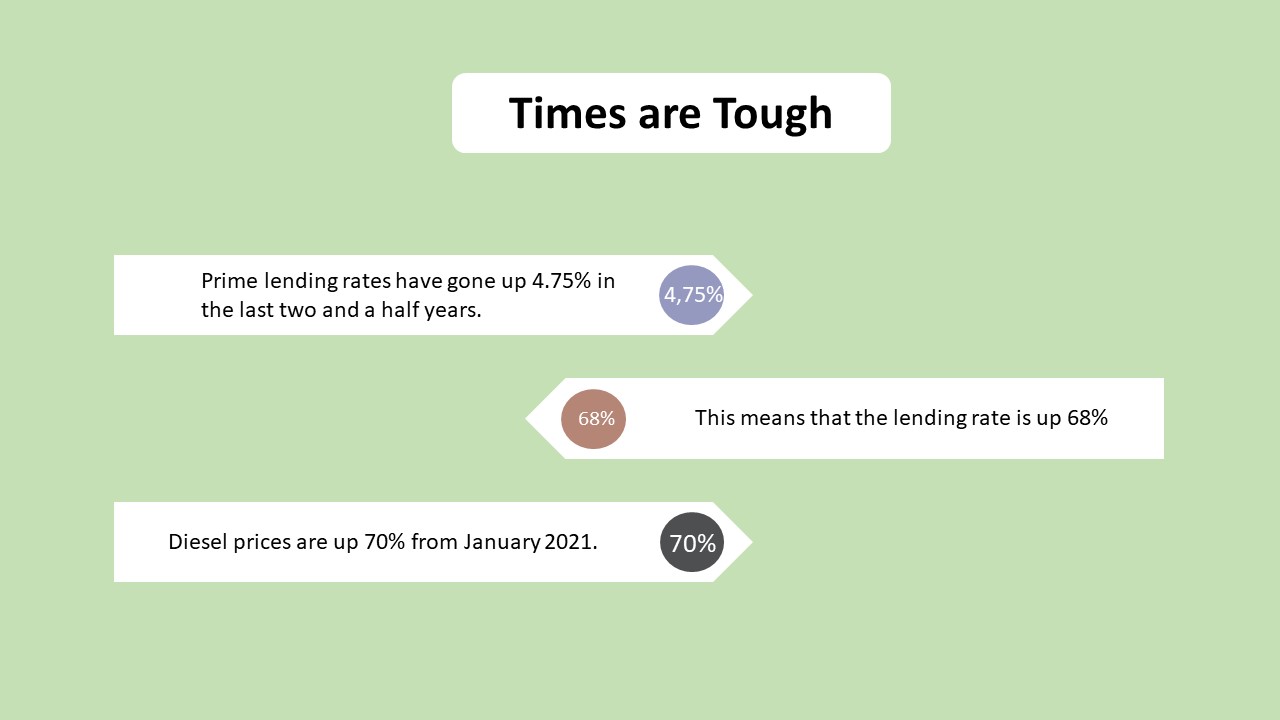
Prime lending rates have gone up by 4.75% in the last two and a half years. That means that the lending rate has increased by 68%. This has greatly affected all South Africans with debt. Diesel prices are up 70% from January 2021. Diesel prices affect almost all consumables through transport. The effect of these increases is devastating to our budget and the full effect is still coming. Middle-class South Africans are loading up on debt to soften the blow, but this can’t go on forever.

According to Eighty20, a data analytics firm, more than 800 000 new entrants entered the credit market in Q4 of 2022. DebtBusters’ reports that their data show that South Africans taking home more than R20 000, pay 68% of their income on debt. 41% of South Africans are in a worse financial position than they were compared to 2022. The average pay of South Africans has declined by more than a tenth.


A R2 000 000 home loan could cost you R5 500 more every month in less than two and a half years of interest rate hikes

If you are paying off a home loan of R2 000 000, your premium would have gone up by about R5 500 a month or 35%. If your home loan is 25% of your expenses, your expenses would have gone up by 8,75% on your housing alone. Add to that food, petrol, electricity, car repayments and you can easily get a 25% or more increase on your monthly expenses. Who of you has received a salary increase of 12% each year over the last two years? Perhaps you are not feeling the pinch like most South Africans do.


My monthly expenses – according to my budget – have gone up by 36% in the last two years. If I didn’t make adjustments about 7 years ago, I would be under debt review right now. Times are tough, but this is not the first time this is happening and certainly not the last. Salary earners are getting poorer by the day and most South Africans are not serious enough about this.


We all know trouble is on the horizon, but very few are doing something about it. Some might even say, they can’t do anything about it. They are helpless; they are merely hoping the situation will improve. But it won’t, it is only getting started and the next 12 months or more could be devastating if you keep on ignoring the inevitable. This blog was written to help you, with tips on how I helped myself out of crippling debt and ignorance.


Here are 6 reasons why you could get into real financial trouble if you don’t make changes soon:

  1. We don’t talk about finances

Okay, so you and your buddies or family members moan about the increasing prices. But do you talk about solutions? How can you cut back on expenses? What is a good investment in bad times? We rarely admit to our financial problems to our peers and are much more likely to gloat about a luxury item we bought. Spending more time talking about good financial habits will help improve your situation. Finding friends or even family to talk openly and honestly about financial struggles might be difficult. We were brought up that our finances were private, but our struggles are not unique.


     2. We are in denial about our finances 

Many of us know that we have a negative cash flow (spend more than we earn), but we put it in the back of our minds and move on. We try not to let it bring us down, or have a negative impact on our already stressful lives. We try to ignore the problem. We are in denial. We don’t accept that we have a problem. And when we don’t accept we have a problem, we will never start to do anything about it.


     3. We do not have a budget or know how to budget 

Very few people have a budget. This is the tool that made me understand that I had a negative cash flow. I was in denial of the fact. It made me realise that if I didn’t make immediate changes, my situation would only get worse. A friend told me that he doesn’t need a budget to tell him that he doesn’t come out with his income, his ever-increasing debt tells him that. When I tried to explain that a budget will show where he is overspending. He simply shrugged off my advice and replied: “I can’t cut anywhere.” In 2017, I also didn’t believe I could cut any expenses or make sacrifices in my budget, but withhin twelve months of changing my financial situation, I cut about R15 000 off my monthly expenses. By the way, the friend I’m referring to is an accountant by profession. He should know better.

Used correctly, a budget doesn’t restrict you; it empowers you

– Tere Stouffer

     4. We are not proactive about our financial future 

If you are like me or the way I used to be, you will keep telling yourself that something will happen to alleviate the problem. One day I will get a massive promotion, with an increase that will solve all my financial troubles or one day I will win the lotto. We put the negative thoughts in the back of our minds and try to drown the thoughts with a bottle of wine or something stronger. The irony is that the problem will only be bigger tomorrow. The promotion is not guaranteed or might come too late and the lotto win is a pipedream. We need to start making the changes to turn our cash flow into a positive sooner rather than later.


     5. We overspend 

There are two parts to personal finance. The one part we have complete control over – that is spending. The other part we have less control over – that is our income. We can do our very best to get a job to pay well or start a business to the best of our ability, but we don’t have complete control over our income. You do however have complete control over your spending habits. 


Some might disagree over the control thereof. You might say, I have to pay for rent, water, electricity, means to travel and food. Yes, there are basic needs that we need to pay for, but how much you spend on those is up to you. 


When we get an increase, we tend to move to a bigger apartment. The rent on the apartment goes up, which might be covered by the increase, but then we relax on the other expenses. We splash a little on new decor. We relax a little on the tight living budget we had previously, because we should have spare money each month. Before we know it, we have racked up debt that we must repay each month and the gain in your net income does not cover the extra rent and the extra debt. Effectively, you have gone backwards and you are locked in for a while. 


Or you decided to buy a new car with your increase. Why? Because you can afford a bigger instalment. The problem is that you devour the increase with the instalment, but what we often do not account for is the fact that the services will cost more, perhaps the new vehicle is not as economical on fuel and a set of tires are more expensive than the previous vehicle. Before you know it, the average monthly cost of the new vehicle versus the old is higher than the increase you received. The overall effect on your budget is negative and you start falling further and further into debt. 


Or you receive a well-deserved bonus and feel you want to treat the family with an expensive holiday destination. The bonus covers the cost of the accommodation, but when you get there, you feel the need to experience some of the adventures that the destination offers. The extra costs rack up a load of debt that becomes a burden for months. What was supposed to be a happy memory has become a burden. Have you ever experienced something similar?


     6. We do not save 

I know I was taught to save by my parents. Thinking back, I think it was only my mom that spread the lesson and the reason the message never stuck was perhaps that there was a second voice that preached the opposite: “Don’t save, spend”. My dad always came up with good excuses to spend money. “We deserve a holiday” or “We can’t just sit in the house the whole weekend”. So the idea of: ‘Saving is a necessity’, was always there, but the habit never stuck, because the spending culture was more rewarding than the saving culture. 


Saving allows for investing. Investments can lead to passive income. Passive income can be invested once more for more passive income until a point where the passive income can replace your salary and release you from the shackles of the rat race. This will take time and discipline, but imagine if we grew a culture where we allow ourselves to only spend our passive income. Imagine if we can teach our children this from the start before they have loads of expenses. Imagine what you can do with your time…


Living on a passive income is possible. Many people do it. We just don’t have the right mindset to achieve it… yet. All of the hurdles (Realisation, ownership, mindset, habits, budget, etc.) are topics that will be discussed extensively in this blog in due time. The blog has been written as a journey from start to finish and is meant to be read that way. You cannot start investing if you haven’t saved money yet. You cannot save if you have too much bad debt. We will address the problems first, work on the habits to change your cash flow to positive and then get to ways to invest for passive income – making money while you sleep. 


If you don’t find a way to make money while you sleep, you will work until you die. 

-Warren Buffett 

For a while now, probably three or four years, I’ve been advocating about how I believe that the stable middle class in South Africa is “vulnerable” to drop to a lower socio-economic class and eventually to poverty. The main contributors will be the high inflation, the small tax base and the overall bad saving versus spending habits of the middle class in South Africa. It was not a prophecy, it was a realisation that salary increases are just not enough to counter inflation and the many other factors why the South African middle class are getting poorer. My advice was simple: “Be proactive, plan for future expenses. Start building extra income streams or be sucked into the vortex of the lower classes.”


So who is the middle class, you might wonder. I’ve searched far and wide, but have been unable to find a definitive answer to this question. There are a few different measures that can define the middle class: Income per person, household income or net worth. 


In this blog, I will refer to the salary-earning middle-class a few times and this is the group I refer to:


The Van Plan definition of the salary-earning, middle-class in South Africa:


Anyone earning between R15 000 and R100 000 in gross income as an employee.


Yes, this is a big spread. But did you know that this makes up less than 10% of South African households?


When I started writing the blog, my research led me to an article  that referred to five social classes in South Africa. To my surprise, the class below the stable middle class was appropriately named, “The Vulnerable middle class”. Vulnerable to the very deep and slippery hole of poverty. 


There is no better day to start improving your financial situation than today. I started doing it six years ago and want to help you along the way. I will share everything that I did from having about R350 000 worth of debt on cars, credit cards, personal loans and overdraft facilities. I was months away from being unable to pay all of my debt commitments. Today, I have no debt other than my home loan. Instead, I have a rather healthy, diversified investment portfolio. It’s been a long road and it’s not finished, but I am a completely different person today. Happy, healthy, without unnecessary financial stress and the habits that I’ve installed insures me that my situation will improve over time. Yes, financial stress is unnecessary and together we can eliminate that.


I once read a story about two sons of an Alcoholic Father. One struggled through life as a drunk, the other became a successful businessman. When asked: “Why are you the way you are?” They both answered: “Because my father was an alcoholic.” 


The one decided that he will not let his father define him. The other used it as an excuse. Making excuses comes more naturally to us, rather than fighting against the natural narrative. My father is not an alcoholic, but at the age of 68 he is still not financially independent; he still has to make an income to make ends meet. This is, unfortunately, the case for many South Africans. I made the decision that I will not follow in his footsteps and made big changes to my lifestyle and spending habits six years ago. Which “son” are you?


Are you the son that believes that there are no opportunities in South Africa to prosper? Or are you the one that learns from the past and makes the best of the opportunities available? Our starting point could be very different, but we decide where the starting point will be for our children. Further back or further forward?