
One late Thursday afternoon in November 2022, a maintenance contractor reaches out underneath a rotating shaft to unscrew a steel plug, smaller than a coffee mug. The removal allows lubrication oil, vital for the smooth operation of one of the eight turbines at Camden power station to operate, to leak freely from the very part it must protect. Within minutes the overheated bearings come to a smoking halt. This act of sabotage will most likely enable another inflated contract for the corrupt repair company.+
Read the full story here.
If you think this is bizarre, read here:
Eskom paid R80,000 for a pair of knee guards that cost R320
At Builders Warehouse
Eskom paid R200,000 for a wooden-handled mop which costs less than R100
At most stores
Eskom paid R26.00 per single one-ply toilet paper roll, which costs R3.99
At Checkers
Eskom paid R51 per black refuse bag, which costs R2.99
At Checkers
If thus didn’t shock you, replace the word “Eskom” with “Taxpayers”.
Electricity prices have gone up by 550% in the 14 years illustrated in the graph below. How much did your salary increase in the last 14 years?

Average annual electricity tariff hikes vs inflation. Source: Anton Eberhard (@AntonEberhard)
Over and above the increase in our electricity bills, we have further bailed out Eskom from a complete blackout due to crippling debt. Unfortunately, corruption does not end with Eskom.
In 2020, then finance minister, Tito Mboweni, confirmed that the cumulative bailouts for state-owned enterprises since 2000 were R187,4bn to date.
This is money that gets recovered from taxes. You and I are indirectly paying so that someone can make a 200 000% profit on a mop or a 25 000% profit on a pair of knee guards. If this does not upset you, you are better than me.
Years ago, South African SOE’s were putting money into the overall state kitty. For the last 20 years or so, taxpayers have had to keep State Owned Enterprises afloat. Did you know that Eskom won the Financial Times’ Power Company of the Year at the annual Global Energy Awards in 2001? By December 2022, Eskom’s debt stood at R422 billion. It takes a special effort to take down South Africa’s once-world-class power utility in such a quick space of time.
At the end of March 2023, National Treasury announced that the government will provide debt relief to Eskom amounting to R254 billion over the next 3 financial years. Where do you think government will get this money?
The government has already increased fuel levies and VAT in recent years to try and fill the holes of corruption. Both contribute greatly to the eventual prices of goods and services. Next time you buy food or clothes, think for a second about how fuel and VAT affected the price of the respective item. Was it transported at any point in its cycle from being in its natural form to when you bought it? Was VAT paid on importing the article or on any material it is packaged in?
Corruption is a massive contributor to inflation; the middle-class’ greatest enemy. You can also thank inflation and therefore corruption for the recent hikes in the prime lending rate. The South African Reserve Bank pushes the repo rate up to control inflation. How does this work? When the lending rate is low, people tend to spend more money, which means that demand is high. When demand is high, product prices gets pushed up. When the lending rate goes up, demand slows down, which in theory will force prices and also inflation down. This is the basics of an economy. Unfortunately, corruption adds another dimension to this equation. When tenders do not get awarded to the best and most price-efficient contractor, due to corruption, the mitigating measures to stem high inflation get nullified.
In the title of this article I use the metaphor to implicate that corruption is like a cancer for a country.
Cancer can go unnoticed for a long time, but when it gets detected, it can be too late to treat.
Cancer is a disease in which some of the body’s cells grow uncontrollably and spread to other parts of the body. Cancer can start anywhere in the body with trillions of cells.
With early detection and treatment, cancer can be controlled and even cured. But ignoring sure telltale signs can have devastating effects.
In the same way, corruption can go undetected or ignored, purposefully or through ignorance. When the real effect of corruption gets realised it has spread to such an extent that key players in the supply chain or in the policing system are already caught up in the claws of the main benefactors. In some cases, the co-operatives are not necessarily willing, but threatened to such an extent that they do have a choice. Or the bribes that they receive are simply too lucrative to waive.
In 2021, University of the Free State chancellor, Bonang Mohale gave the following sickening results: “It is broadly estimated that there was a whopping R1.5 trillion lost to our country between just 2014 and 2019. This is not to mention that some of our elected leaders continue to steal from the poor, hungry, sick and dying.”
Have you ever seen the Netflix series “Narcos”? For me, this was such an eye-opener on how a drug cartel captured a country, from the police to the government and then made the people believe that the drug lords are the good guys. The amount of corruption, whistleblowers and good guys that get assassinated, made me wonder how far South Africa is away from that.
I can’t help but feel, that the recent assassinations of politicians, whistleblowers and the attempt on the life of a recent CEO of Eskom that has laid bare the corruption and sabotage at Eskom, is the direct influence from the kingpins that gets the biggest monetary benefit from the deals mentioned at the beginning of this article.
If you have never watched Narcos, I can really recommend it for the brutally honest telling of how the greed of the drug lords leads to thousands of deaths, and the destruction of communities and eventually cities for the enrichment of a few. It opened my eyes to the lengths that the benefactors would go through to ensure their riches.
Just be warned that it comes with a warning for sensitive viewers.
The idea of this post is not to point fingers at anybody, but to rather open the eyes of salary earners to the destructive nature of corruption of their own wealth.
We all know the story of Hansie Cronje. Once the darling of South African cricket. I think we all accept that Hansie was not a bad guy. He just had one bad trait. His love for money. He was lured in slowly, and before he could get out, he was tangled in the sly web of match-fixing.
Corruption will always be around. In recent years the man on the street has come to understand that our leaders whom we once backed to grow our economy, are now the ones caught up in the ever-growing snowball of corruption. I don’t think that all people caught up in corruption, planned to get involved. They were just the connection. The syndicates; the real benefactors, would not allow anything to stop them from getting their slice of the pie.
So how does corruption contribute to inflation and ultimately the pockets of the salary-earning middle class?
Corruption led to loadshedding through money ill-directed at procuring products at inflated prices that could have been used for maintenance. It was also caused by appointing incapable contractors to work at exorbitant prices, leading to rework and longer downtime. Eventually, Eskom ran into so much debt, that the only way to keep the lights on, sometimes, was to gather bailout money from the taxpayers. Add to that, that SA is running out of taxpayers, and you should realize that the time to plan your finances with professional help is now.
The middle class will always bear the largest brunt of the effects of corruption through taxes and levies. If it doesn’t affect you directly, you will eventually be affected by the rising cost of living, or inflation. You might as well accept it, get in the game and start playing it. The South African Reserve Bank’s inflation goal is between 3-6%. Inflation, as I write this, is hovering around 7%, which means that your investment needs to outperform 7% after tax. Here is a graph that illustrates how a saving of R3 000 a month can grow in relative terms if you can beat inflation by various percentages.
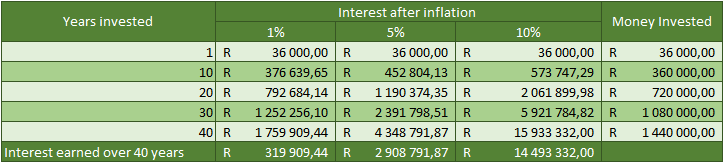
In the first column (1%), we look at the scenario where you get 8% on your returns and only outperform inflation by 1%. You should be able to achieve this with a fund with a decent track record.
In the second column (5%), we see a scenario where you outperform inflation by 5%. This can be achieved in an investment with 8% returns and when the lower inflation goal is achieved by SARB. Or in an investment that outperforms our current inflation by 5%. An investment that gives returns of 12% after tax is rare.
In the third column (10%), we see a scenario where your portfolio outperforms inflation by 10%. This can be achieved in an investment with 13% returns and when the lower inflation goal is achieved by SARB. Or in an investment that outperforms our current inflation by 10%, therefore 17% after tax. This is very rare, but possible with good financial planning, taking advantage of tax incentives and staying in the market for a long period.
The first objective of this illustration is to show that the higher inflation is, the more difficult it is to save for retirement. The second objective was to show the advantages of starting early and getting good professional advice.
If we look at the last row, we can see the interest that was accumulated over 40 years. At 1%
Your interest over the 40 year period is only 22%. If you are able to beat inflation by 5% consistently over 40 years, your interest is more than double the money that you physically invested. And if you can beat inflation with more than 10% over 40 years, your interest earned will be more than 10 times the payments that you made over the period.
Every percentage of inflation makes it more difficult to save for retirement and corruption is contributing in a big way towards our soaring inflation.
Corruption is deeply embedded in our country. Like cancer, it is not a quick fix to get rid of it. It is a stubborn weed that is difficult to get rid of completely. High inflation is most likely here to stay. You can use it as an excuse to not do anything or it can be your reason to do something to counter it.
What can we do about this? Other than the obvious, fight it tooth and nail, there are certain habits that you can adopt to limit the effect of inflation. This is by educating ourselves about how we can plan our finances to still beat inflation when investing. Do you have a plan? Are you invested in your plan? Excuse the pun. Or do you stand on the side, blame others for your problems and put your hopes in faith that something or someone else will save you? How often has standing on the sidelines accomplished anything?


No comment yet, add your voice below!