

In 2016, I was drowning in debt. Between me and my wife, we had 3 Credit cards, well in the red, 2 personal loans, 2 overdraft facilities well in the red, a car loan and we just had our first child. Our bad debt stood at about R350 000. We also had 2 home loans, but let’s call that “good debt”.
We were about to find out that my parents were in no position to retire at 65, with just 5 years to go and there was a genuine chance that I will have to help them financially in the near future. We would have carried on living from month to month for years to come, but then the worst thing possible happened to someone drowning in debt… and that changed my life.
Today (October 2022) I am in more control of my finances than ever been… even after quitting my job and have not yet applied for a new permanent job, 12 months later. I am free of the burdens of financial stress. I understand my financial situation, being in control of my spending and understanding the limits of my income. I don’t have any bad debt, I have a diversified investment portfolio and I earn a passive income through four streams, with another running at a loss, but hoping to turn it around soon. It’s not a big income yet, but it is a step in the right direction. In my first post, I talked about how I believe that middle-class, salary-earning South Africans are in real danger of falling into poverty over time. Creating passive income streams is the way to counter this.
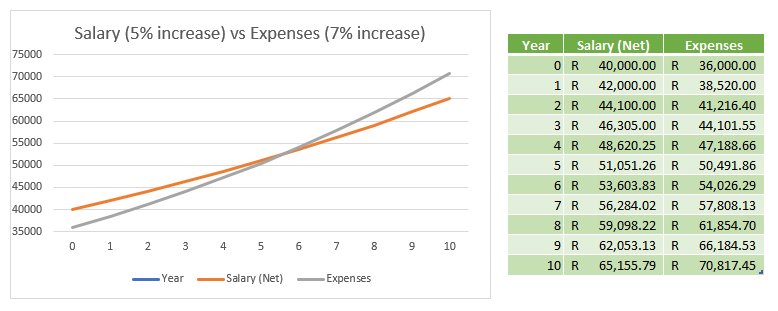
The graph shows how quickly your expenses catch up with your salary when you get a 5% salary increase, but your expenses increase by 7% year-on-year, if you spend 90% of your income in year 1.
For most of my life, I’ve thought of myself as a problem solver and more than adequate at mathematics. Unfortunately, this did not reflect in my finances. My finances reflected ignorance and someone detached from reality. I was very lucky that I was slapped in the face with a reality check not once, but three times between 2016 and 2017. If it was not for this, I probably would never have turned my finances and simultaneously my life around.
In essence, I had terrible financial habits and although I wouldn’t accept it myself back then, I was lacking financial literacy. I had no idea how much money I would need to be financially independent and with time I learned that this was not an isolated case.
Financial Independence according to Wikipedia is the status of having enough income or wealth sufficient to pay one’s living expenses for the rest of one’s life without having to be employed or dependent on others. Income earned without having to exchange your time for it is commonly referred to as passive income. Growing your passive income over time to eventually cover all your expenses, will make you financially independent. I prefer the term financial independence to retirement, as we have an age correlated to retirement; even an image of someone well into their life. Grey hair with wrinkles; an older version of ourselves, but a happier one due to the freedom of retirement.
I get the idea that a lot of people think that they will retire at age 65 no matter what. Somewhere in their life, they put money away towards a pension or provident fund and therefore they can stop working at 65. Unfortunately, this is where the very big misunderstanding starts. This is why I like to refer to such a time as financial independence. It can happen much earlier than 65, but due to our very bad financial planning it usually happens way after 65 and in most cases never.
There are very easy calculations that you can do to guestimate how much money you need to become financially independent:
For example, take the monthly income you feel you would require and multiply it by 300. It is not a perfect solution, since many factors would influence the result, but it is good enough to set your thinking in motion to where you should aim.
If you and your partner feel you need R40 000 a month to live comfortably:
R40 000 X 300 = R12 000 000
Why did we do this? In the financial industry, they talk about the 4% rule. This is where you live on only 4% of your capital in an attempt to preserve your capital since you don’t know how long you will live. Therefore 4% of R12 000 000 equals R480 000 per year or R40 000 per month. Why do we use 4%? In order to keep the value of our capital over time, we need to keep up with inflation. South Africa’s inflation target band is between 3% and 6%. Unfortunately, we have been closer to the upper side of this band in recent history and therefore if you can grow your capital around 10% annually, you can only draw 4% annually to keep the value of your capital.
What is important to understand, is that the R12 000 000 is in today’s value. You will have to adjust your target every year to stay with the rising cost of living.
What even more people miss is how long it takes to save up this sort of money. This is not an amount accumulated by putting a few hundred rands into a savings account at your bank. This takes careful planning for many years. My Financial Planner gave me an example that shook me to the core. The example he used ignores inflation and interest for ease of concept. Or if you want to be more practical, you live in a country where inflation is 6% and the bank you save your money, gives you 9%, but after taxes, your real return is 6%. Inflation and interest balance out.
If you are 45 years old and plan to put money away until you are 65 (for 20 years), and plan to have saved up money to pay you R40 000 per month for 20 years (until 85). How much do you have to put away?


No comment yet, add your voice below!