

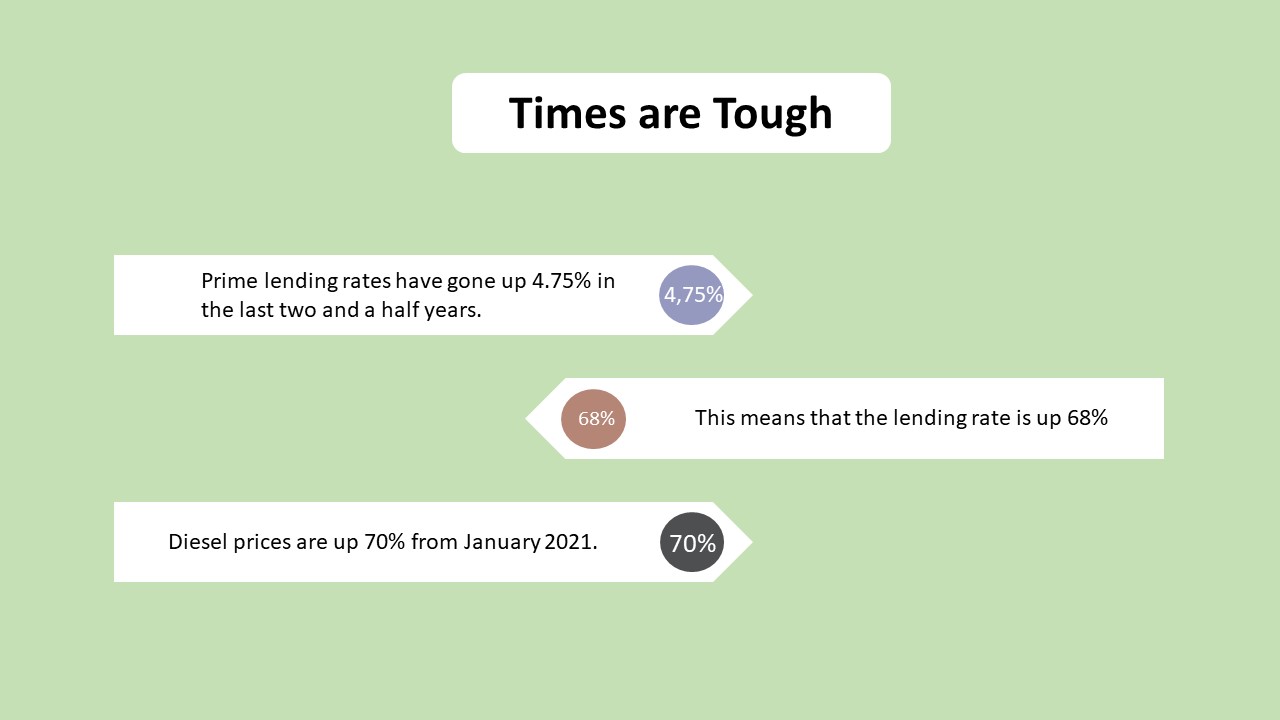
Prime lending rates have gone up by 4.75% in the last two and a half years. That means that the lending rate has increased by 68%. This has greatly affected all South Africans with debt. Diesel prices are up 70% from January 2021. Diesel prices affect almost all consumables through transport. The effect of these increases is devastating to our budget and the full effect is still coming. Middle-class South Africans are loading up on debt to soften the blow, but this can’t go on forever.
According to Eighty20, a data analytics firm, more than 800 000 new entrants entered the credit market in Q4 of 2022. DebtBusters’ reports that their data show that South Africans taking home more than R20 000, pay 68% of their income on debt. 41% of South Africans are in a worse financial position than they were compared to 2022. The average pay of South Africans has declined by more than a tenth.

–
A R2 000 000 home loan could cost you R5 500 more every month in less than two and a half years of interest rate hikes
–
If you are paying off a home loan of R2 000 000, your premium would have gone up by about R5 500 a month or 35%. If your home loan is 25% of your expenses, your expenses would have gone up by 8,75% on your housing alone. Add to that food, petrol, electricity, car repayments and you can easily get a 25% or more increase on your monthly expenses. Who of you has received a salary increase of 12% each year over the last two years? Perhaps you are not feeling the pinch like most South Africans do.
My monthly expenses – according to my budget – have gone up by 36% in the last two years. If I didn’t make adjustments about 7 years ago, I would be under debt review right now. Times are tough, but this is not the first time this is happening and certainly not the last. Salary earners are getting poorer by the day and most South Africans are not serious enough about this.
We all know trouble is on the horizon, but very few are doing something about it. Some might even say, they can’t do anything about it. They are helpless; they are merely hoping the situation will improve. But it won’t, it is only getting started and the next 12 months or more could be devastating if you keep on ignoring the inevitable. This blog was written to help you, with tips on how I helped myself out of crippling debt and ignorance.
Here are 6 reasons why you could get into real financial trouble if you don’t make changes soon:
- We don’t talk about finances
Okay, so you and your buddies or family members moan about the increasing prices. But do you talk about solutions? How can you cut back on expenses? What is a good investment in bad times? We rarely admit to our financial problems to our peers and are much more likely to gloat about a luxury item we bought. Spending more time talking about good financial habits will help improve your situation. Finding friends or even family to talk openly and honestly about financial struggles might be difficult. We were brought up that our finances were private, but our struggles are not unique.
2. We are in denial about our finances
Many of us know that we have a negative cash flow (spend more than we earn), but we put it in the back of our minds and move on. We try not to let it bring us down, or have a negative impact on our already stressful lives. We try to ignore the problem. We are in denial. We don’t accept that we have a problem. And when we don’t accept we have a problem, we will never start to do anything about it.
3. We do not have a budget or know how to budget
Very few people have a budget. This is the tool that made me understand that I had a negative cash flow. I was in denial of the fact. It made me realise that if I didn’t make immediate changes, my situation would only get worse. A friend told me that he doesn’t need a budget to tell him that he doesn’t come out with his income, his ever-increasing debt tells him that. When I tried to explain that a budget will show where he is overspending. He simply shrugged off my advice and replied: “I can’t cut anywhere.” In 2017, I also didn’t believe I could cut any expenses or make sacrifices in my budget, but withhin twelve months of changing my financial situation, I cut about R15 000 off my monthly expenses. By the way, the friend I’m referring to is an accountant by profession. He should know better.
“
Used correctly, a budget doesn’t restrict you; it empowers you
– Tere Stouffer
4. We are not proactive about our financial future
If you are like me or the way I used to be, you will keep telling yourself that something will happen to alleviate the problem. One day I will get a massive promotion, with an increase that will solve all my financial troubles or one day I will win the lotto. We put the negative thoughts in the back of our minds and try to drown the thoughts with a bottle of wine or something stronger. The irony is that the problem will only be bigger tomorrow. The promotion is not guaranteed or might come too late and the lotto win is a pipedream. We need to start making the changes to turn our cash flow into a positive sooner rather than later.
5. We overspend
There are two parts to personal finance. The one part we have complete control over – that is spending. The other part we have less control over – that is our income. We can do our very best to get a job to pay well or start a business to the best of our ability, but we don’t have complete control over our income. You do however have complete control over your spending habits.
Some might disagree over the control thereof. You might say, I have to pay for rent, water, electricity, means to travel and food. Yes, there are basic needs that we need to pay for, but how much you spend on those is up to you.
When we get an increase, we tend to move to a bigger apartment. The rent on the apartment goes up, which might be covered by the increase, but then we relax on the other expenses. We splash a little on new decor. We relax a little on the tight living budget we had previously, because we should have spare money each month. Before we know it, we have racked up debt that we must repay each month and the gain in your net income does not cover the extra rent and the extra debt. Effectively, you have gone backwards and you are locked in for a while.
Or you decided to buy a new car with your increase. Why? Because you can afford a bigger instalment. The problem is that you devour the increase with the instalment, but what we often do not account for is the fact that the services will cost more, perhaps the new vehicle is not as economical on fuel and a set of tires are more expensive than the previous vehicle. Before you know it, the average monthly cost of the new vehicle versus the old is higher than the increase you received. The overall effect on your budget is negative and you start falling further and further into debt.
Or you receive a well-deserved bonus and feel you want to treat the family with an expensive holiday destination. The bonus covers the cost of the accommodation, but when you get there, you feel the need to experience some of the adventures that the destination offers. The extra costs rack up a load of debt that becomes a burden for months. What was supposed to be a happy memory has become a burden. Have you ever experienced something similar?
6. We do not save
I know I was taught to save by my parents. Thinking back, I think it was only my mom that spread the lesson and the reason the message never stuck was perhaps that there was a second voice that preached the opposite: “Don’t save, spend”. My dad always came up with good excuses to spend money. “We deserve a holiday” or “We can’t just sit in the house the whole weekend”. So the idea of: ‘Saving is a necessity’, was always there, but the habit never stuck, because the spending culture was more rewarding than the saving culture.
Saving allows for investing. Investments can lead to passive income. Passive income can be invested once more for more passive income until a point where the passive income can replace your salary and release you from the shackles of the rat race. This will take time and discipline, but imagine if we grew a culture where we allow ourselves to only spend our passive income. Imagine if we can teach our children this from the start before they have loads of expenses. Imagine what you can do with your time…
Living on a passive income is possible. Many people do it. We just don’t have the right mindset to achieve it… yet. All of the hurdles (Realisation, ownership, mindset, habits, budget, etc.) are topics that will be discussed extensively in this blog in due time. The blog has been written as a journey from start to finish and is meant to be read that way. You cannot start investing if you haven’t saved money yet. You cannot save if you have too much bad debt. We will address the problems first, work on the habits to change your cash flow to positive and then get to ways to invest for passive income – making money while you sleep.
“
If you don’t find a way to make money while you sleep, you will work until you die.
-Warren Buffett
For a while now, probably three or four years, I’ve been advocating about how I believe that the stable middle class in South Africa is “vulnerable” to drop to a lower socio-economic class and eventually to poverty. The main contributors will be the high inflation, the small tax base and the overall bad saving versus spending habits of the middle class in South Africa. It was not a prophecy, it was a realisation that salary increases are just not enough to counter inflation and the many other factors why the South African middle class are getting poorer. My advice was simple: “Be proactive, plan for future expenses. Start building extra income streams or be sucked into the vortex of the lower classes.”
So who is the middle class, you might wonder. I’ve searched far and wide, but have been unable to find a definitive answer to this question. There are a few different measures that can define the middle class: Income per person, household income or net worth.
In this blog, I will refer to the salary-earning middle-class a few times and this is the group I refer to:
The Van Plan definition of the salary-earning, middle-class in South Africa:
Anyone earning between R15 000 and R100 000 in gross income as an employee.
Yes, this is a big spread. But did you know that this makes up less than 10% of South African households?
When I started writing the blog, my research led me to an article that referred to five social classes in South Africa. To my surprise, the class below the stable middle class was appropriately named, “The Vulnerable middle class”. Vulnerable to the very deep and slippery hole of poverty.
There is no better day to start improving your financial situation than today. I started doing it six years ago and want to help you along the way. I will share everything that I did from having about R350 000 worth of debt on cars, credit cards, personal loans and overdraft facilities. I was months away from being unable to pay all of my debt commitments. Today, I have no debt other than my home loan. Instead, I have a rather healthy, diversified investment portfolio. It’s been a long road and it’s not finished, but I am a completely different person today. Happy, healthy, without unnecessary financial stress and the habits that I’ve installed insures me that my situation will improve over time. Yes, financial stress is unnecessary and together we can eliminate that.
I once read a story about two sons of an Alcoholic Father. One struggled through life as a drunk, the other became a successful businessman. When asked: “Why are you the way you are?” They both answered: “Because my father was an alcoholic.”
The one decided that he will not let his father define him. The other used it as an excuse. Making excuses comes more naturally to us, rather than fighting against the natural narrative. My father is not an alcoholic, but at the age of 68 he is still not financially independent; he still has to make an income to make ends meet. This is, unfortunately, the case for many South Africans. I made the decision that I will not follow in his footsteps and made big changes to my lifestyle and spending habits six years ago. Which “son” are you?
Are you the son that believes that there are no opportunities in South Africa to prosper? Or are you the one that learns from the past and makes the best of the opportunities available? Our starting point could be very different, but we decide where the starting point will be for our children. Further back or further forward?

No comment yet, add your voice below!